 LittleRoadsCo.
Gifts for the kid who already has everything
You know the kid. Their playroom looks like a toy store. They got the hot item last Christmas and the one before that. Their parents, when asked what to buy, say something polite that roughly translates to "please don't bring more stuff into this house." Shopping for this child feels impossible because the obvious gifts are already covered. The trick is to stop looking for a better version of what they have and find something from a category they haven't encountered yet.
Why "unique" usually means "weird"
Gift guides for the kid who has everything tend to go in one of two directions. Either they suggest expensive versions of normal toys (a $200 wooden train set instead of a $40 one) or they suggest novelty items that are interesting for about fifteen minutes (a kit that lets you grow crystals, a DIY slime box, a subscription to a monthly mystery crate). The expensive route feels wasteful. The novelty route produces a brief moment of excitement followed by permanent residence in a drawer.
The actual solution is simpler than either of these. You need a gift that the child literally cannot already own, because it didn't exist until you ordered it. A custom product solves the "has everything" problem structurally. If the item is made specifically for this child, based on their specific address, featuring their specific neighborhood, it's not possible for them to already have it. The uniqueness isn't a marketing claim. It's a physical fact.
A gift from a category that doesn't exist yet in their playroom
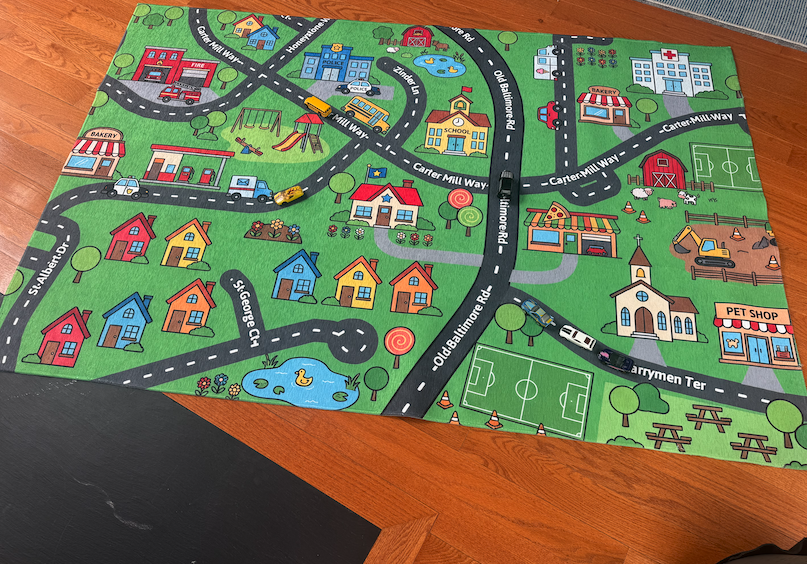
The kid who has everything has action figures, stuffed animals, building sets, art supplies, outdoor toys, and probably a tablet. What they almost certainly don't have is a rug on their floor that shows their actual neighborhood. It's not a toy, exactly. It's not decor, exactly. It's a play surface that happens to be a map of the place they live, illustrated in a style that invites toy cars and imagination.
That's why it works for this particular child. It doesn't compete with anything in the toybox. It sits underneath the toybox, on the floor, and changes the way the existing toys get played with. The cars they already own now have somewhere specific to drive. The figurines they already have now live in a neighborhood with streets and buildings. The gift doesn't add to the pile. It transforms the pile.
It also passes the parent test. The parent who said "please no more toys" is not going to be upset about a rug. It's functional. It's flat. It replaces a blank patch of floor with something their child will actually use. The gift-giver gets credit for being thoughtful rather than oblivious, which is a meaningful distinction when you're buying for a family that already has too much.
The unwrapping moment
There's a specific reaction that happens when a child who has seen every toy in every store opens something they've genuinely never encountered before. It's not the polished "thank you" they've learned to perform. It's confusion, then recognition, then excitement. "Wait, is that my house? Is that my street? Where's my school?" The child who has everything suddenly has something nobody else has. That novelty is real, and it lasts longer than the novelty of a toy they could have found in a store.
For the gift-giver, that reaction is the whole point. You didn't just buy something expensive. You bought something they couldn't have predicted, something that made them look at you like you understood something about their world that other adults didn't. That's the gift within the gift, and it's worth more than whatever the rug costs.
The gift they can't already have
Enter their address and we'll create a custom play mat of their neighborhood. It didn't exist before you ordered it. That's the point.