 LittleRoadsCo.
The case for letting kids play pretend
A child pushes a toy car across a rug and suddenly the living room is a whole city. The couch is a mountain. The dog is traffic. This is how kids figure out how the world works, and it costs nothing but a little space and the right surface to play on.
What counts as imaginative play?
Imaginative play is when a child invents a scenario and acts it out. Sometimes it looks like a tea party with stuffed animals. Sometimes it looks like a four-year-old narrating an elaborate rescue mission under the kitchen table. The specifics vary wildly, but the underlying pattern is the same: the child is building a world in their head and then living inside it for a while.
Researchers call this "pretend play" or "symbolic play." Piaget placed it squarely in the preoperational stage, roughly ages two through seven, and later reviews have confirmed that timeline (Fein, 1981, Child Development). But it doesn't stop there. Older kids do it too. They just get quieter about it.
The key ingredient is that the child is directing the experience. Nobody is telling them what to do next. There's no screen feeding them the next scene. They decide that the blue car is the ambulance and the red one belongs to the fire chief, and if you try to correct them, you'll hear about it.
Why this kind of play matters so much
When a child pretends to be a doctor, they have to think about what a doctor does, how a patient feels, and what to say to make someone feel better. That's empathy practice, and they're doing it voluntarily because it's fun. No worksheet required.
Pretend play also exercises what psychologists call "executive function." That's the mental machinery for planning ahead, holding information in working memory, and controlling impulses. Research on play-based curricula like Tools of the Mind has shown measurable improvements in these skills (Diamond & Lee, 2011, Science). When a kid decides to play restaurant, they have to remember the orders, figure out the sequence of cooking, and resist the urge to eat all the pretend food themselves. It's harder than it sounds.
There's a language component too. Research by Anthony Pellegrini at the University of Minnesota found that children engaged in dramatic play produced more complex language than in other contexts (Pellegrini, 1980, Psychology in the Schools). They're practicing being articulate because the story demands it.
And then there's the emotional piece. Playing pretend gives kids a low-stakes way to process things that confuse or worry them. A child who just went to the dentist might spend the next week giving dental exams to every toy in the house. That's not random. That's a kid making sense of an experience by replaying it on their own terms.
Physical space shapes the story
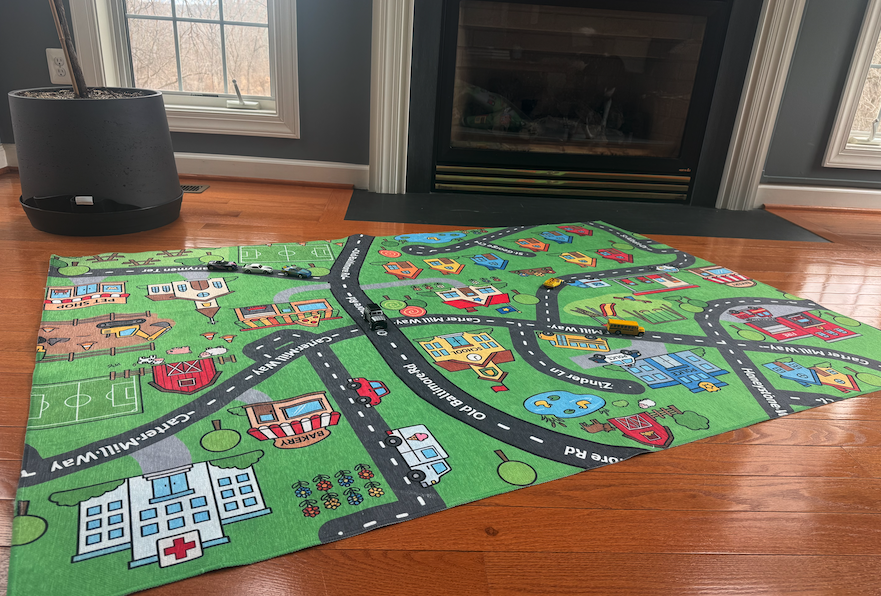
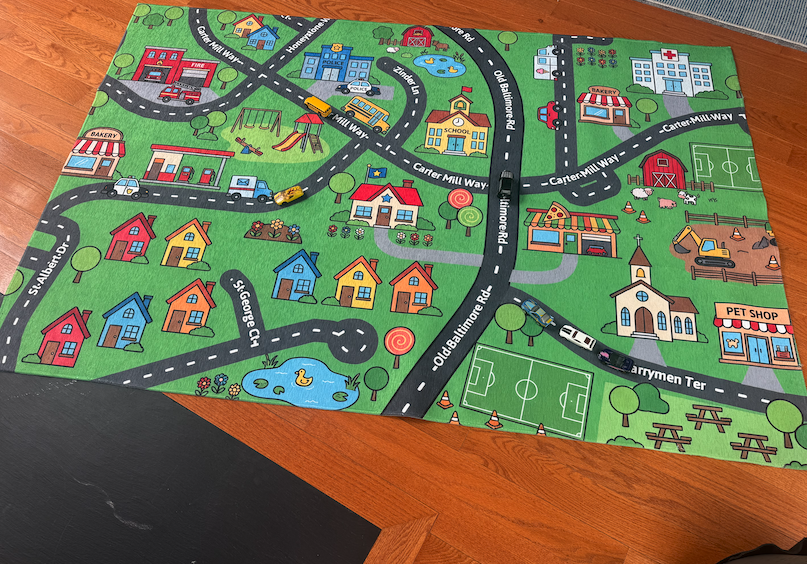
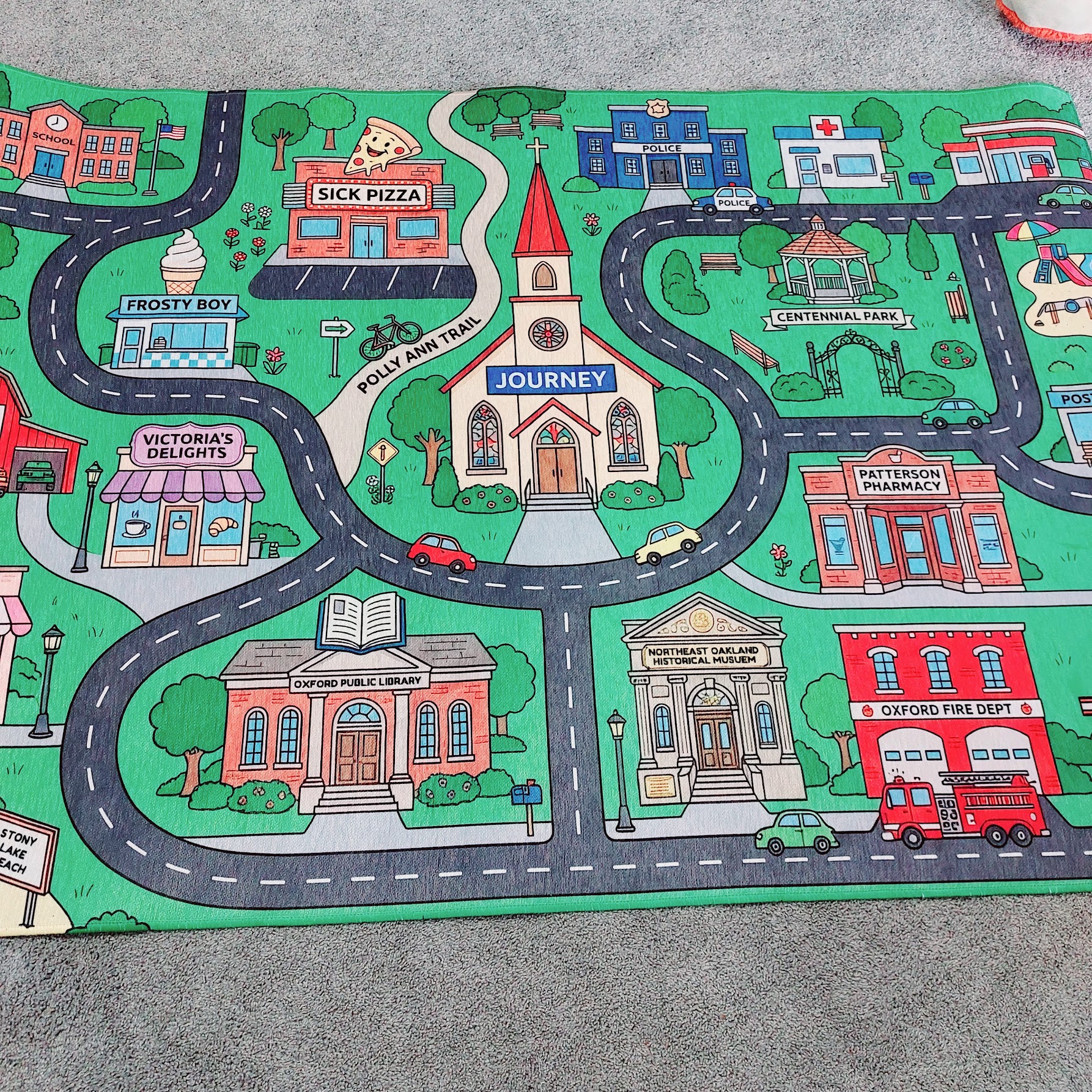
There's a reason kids gravitate toward play mats and rugs with roads on them. A printed surface gives just enough structure to launch a story without dictating where it goes. The roads suggest movement. The buildings suggest destinations. But the child fills in everything else.
This is what toy designers mean by "open-ended play." The best toys don't tell kids what to do. They suggest a starting point and then get out of the way. Blocks do this. Dolls do this. And a good play mat does this, especially when the roads and buildings on it look like a place the child actually recognizes.
That's what makes a personalized play mat different from a generic one. When a kid sees their own street, their own neighborhood, their actual house with a little flag on it, the play becomes personal. They're not just pushing cars around some random town. They're driving to Grandma's house. They're going to the park down the street. The stories connect to their real life, and that connection makes the play stickier and more meaningful.
Screens vs. the floor
This isn't an anti-screen rant. Screens have their place. But the research is pretty clear that passive screen time doesn't build the same cognitive muscles as active pretend play. When a child watches a cartoon, the story is happening to them. When they play pretend, the story is happening because of them. That distinction matters more than most parents realize.
The American Academy of Pediatrics has been saying for years that unstructured play is essential for healthy brain development. Their 2018 clinical report called it "brain building" (Yogman et al., Pediatrics). Not supplemental. Essential. And yet the average American child spends dramatically more time in front of screens than they do in self-directed play. The pandemic accelerated that trend, and it hasn't fully reversed.
The fix isn't complicated. You don't need a Pinterest-worthy playroom. You need a clear patch of floor, some toys that don't beep or glow, and the willingness to let your kid make a mess for a while.
How play changes as kids grow
At two, imaginative play looks simple. A kid might hold a banana to their ear and say "hello." That's it. That's the whole game. But it's a huge developmental leap because it means the child understands that one thing can stand in for another.
By three or four, the scenarios get more elaborate. There are characters now, and dialogue, and sometimes surprisingly detailed plot lines. This is the age when play mats really come alive. A four-year-old with toy cars and a mat full of roads can entertain themselves for an astonishing amount of time.
Between five and seven, kids start incorporating rules into their pretend play. The fire truck has to go to the fire station first. The grocery store is closed on Sundays. These self-imposed rules are actually how children practice understanding social norms and systems. They're building mental models of how the real world operates.
After seven, pretend play doesn't disappear. It just goes underground. It becomes daydreaming, storytelling, world-building in notebooks. Sandra Russ's longitudinal research at Case Western Reserve found that the quality of pretend play in early childhood predicted higher divergent thinking scores years later (Russ et al., 1999, Creativity Research Journal). That's not a guarantee of anything. But the correlation is strong enough to take seriously.
Give them a world they already know
A Little Roads play mat turns your actual neighborhood into a surface built for imagination. Real streets, real landmarks, your house right in the middle. Just add toy cars.