 LittleRoadsCo.
Kids who know their neighborhood are different
There's a particular kind of confidence that comes from knowing where you are. From being able to point and say "the library is that way" or "my friend lives past the big tree." It sounds small, but for a young child, that knowledge is foundational. It's how they start to understand that they exist in a place, and that the place is theirs.
What researchers mean by "place attachment"
Environmental psychologists have been studying how people bond with places for decades. The technical term is "place attachment," and it describes the emotional connection between a person and a specific location. For adults, this might be a hometown or a house they lived in for twenty years. For children, the scale is smaller and more immediate. It's their street. Their yard. The walk to school.
Gordon Jack, writing in the British Journal of Social Work, made the case that place attachment isn't just sentimental for children. It's functional. Kids who feel connected to their physical surroundings show stronger emotional wellbeing and a more stable sense of security (Jack, 2010, British Journal of Social Work). The familiar landscape becomes a kind of anchor. When the rest of the world feels unpredictable, the child still knows exactly where the corner store is.
This isn't about living in a nice neighborhood. It's about living in a known one. A child who can narrate a walk around their block is a child who has organized a piece of the world in their head and made it their own.
How kids build a map in their heads
In the 1970s, a developmental psychologist named Roger Hart spent two years in a small New England town studying how children experienced their surroundings. He followed kids aged three to twelve, mapping their territories, noting which places they knew and which they avoided, watching how their spatial world expanded year by year. The result, Children's Experience of Place, remains one of the most detailed accounts of childhood geography ever published (Hart, 1979).
What Hart observed, and what Siegel and White had theorized a few years earlier, is that children build spatial knowledge in stages. First come landmarks. A child learns to recognize the red mailbox, the big oak tree, the house with the dog. Then comes route knowledge. The child connects those landmarks into paths: this is the way to the playground, this is the way home. Finally, and usually not until age eight or nine, comes survey knowledge. That's the bird's-eye view. The mental map. The ability to understand how places relate to each other even without walking between them (Siegel & White, 1975, Advances in Child Development and Behavior).
That progression from landmarks to routes to maps is universal. Every child does it. But the speed and richness of it depends on exposure. A child who walks their neighborhood regularly develops a more detailed mental map than one who only sees it through a car window. The landmarks have to be encountered at a child's pace, on foot, at eye level, over and over again.
The shrinking world of childhood
In 1971, 80% of English primary school children walked to school on their own. By 1990, that number had dropped to 9%. Mayer Hillman's landmark study documented this collapse in children's independent mobility and raised an uncomfortable question: what do children lose when they stop navigating the world on their own (Hillman et al., 1990, One False Move)?
The answer, according to subsequent research, is quite a lot. Rissotto and Tonucci found a direct link between children's independent mobility and their environmental knowledge. Kids who moved through their neighborhood on their own developed richer spatial understanding and stronger orientation skills than those who were driven everywhere (Rissotto & Tonucci, 2002, Journal of Environmental Psychology).
The trend in the United States has followed a similar trajectory. Fewer kids walk. Fewer kids ride bikes to a friend's house. Fewer kids know what's two blocks over because they've never had a reason to go there unsupervised. The reasons are complicated and mostly well-intentioned. But the developmental cost is real: a generation of kids who are less spatially confident, less geographically literate, and less connected to the place they actually live.
The places that stay with you
Ask any adult to describe the neighborhood they grew up in and watch what happens to their face. The memories are vivid and specific in a way that surprises even the person telling them. The crack in the sidewalk they used to jump over. The neighbor's fence they could see through. The vacant lot where everything important happened.
Louise Chawla, a researcher who has spent her career studying how childhood environments shape adult identity, calls these "childhood place attachments." Her work shows that the places we inhabit as young children become deeply woven into who we are. They don't just live in memory as neutral backdrops. They carry emotional weight. They anchor our sense of self to a specific piece of the world (Chawla, 1992, in Place Attachment).
Clare Cooper Marcus, working in the same vein, used what she called "environmental autobiography" to study how people's earliest spatial memories influenced their adult lives. Again and again, her subjects returned to the same themes: the feeling of a particular room, the view from a window, the layout of a street (Cooper Marcus, 1992, in Place Attachment). The childhood landscape isn't forgotten. It becomes part of the operating system.
Learning that starts where you live
There's a movement in education called place-based learning, and the premise is straightforward: kids learn better when the subject matter is connected to somewhere they actually know. Instead of studying watersheds in the abstract, study the creek behind the school. Instead of reading about community in a textbook, map the actual community outside the window.
David Sobel, who has written the most widely read book on the subject, argues that young children need to develop a deep attachment to one place before they can meaningfully care about the wider world. You can't expect a seven-year-old to worry about the Amazon rainforest if they don't yet have a relationship with the patch of woods at the end of their street (Sobel, 2004, Place-Based Education).
Gruenewald expanded on this idea in a widely cited paper in Educational Researcher, arguing that place-based education isn't a nice supplement to regular schooling. It's a fundamentally better way to teach, because it gives abstract concepts a physical reality that children can see and touch and walk through (Gruenewald, 2003, Educational Researcher).
What this means for the living room floor
Most parents aren't in a position to redesign their child's school curriculum. But they can do something simpler: make the local environment a thing the family talks about, notices, and plays with.
When a child looks at a map of their neighborhood and can point to their house, their school, and the park where they go on Saturdays, something clicks. The world gets a little less abstract and a little more theirs. That's the beginning of spatial confidence. It's also the beginning of caring about a place, which is the beginning of caring about community, which is something we could all use more of.
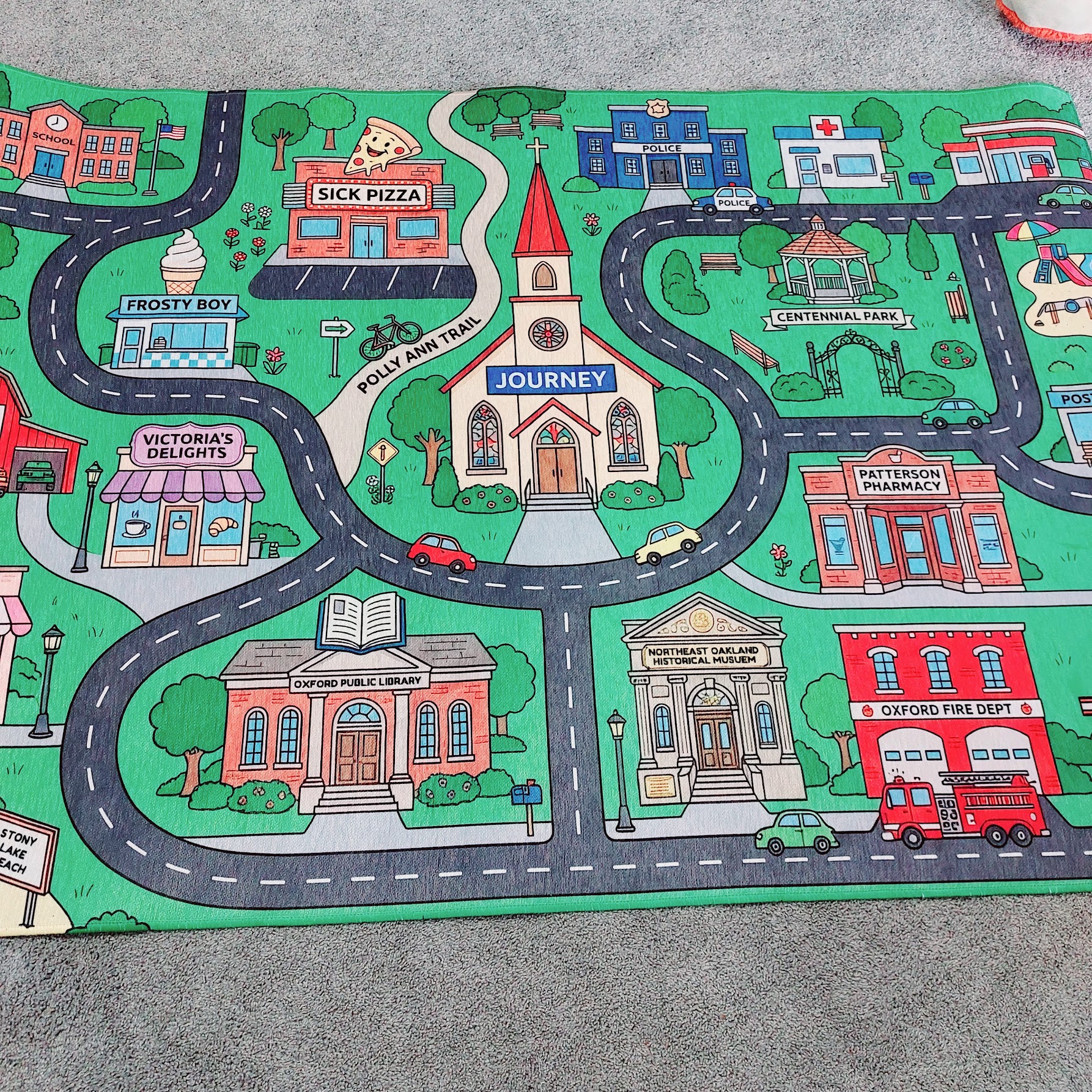
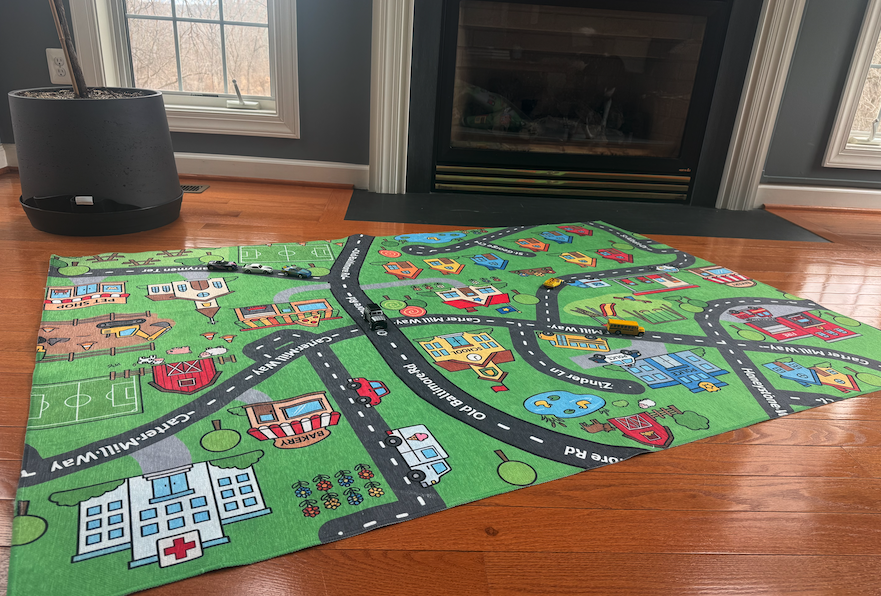
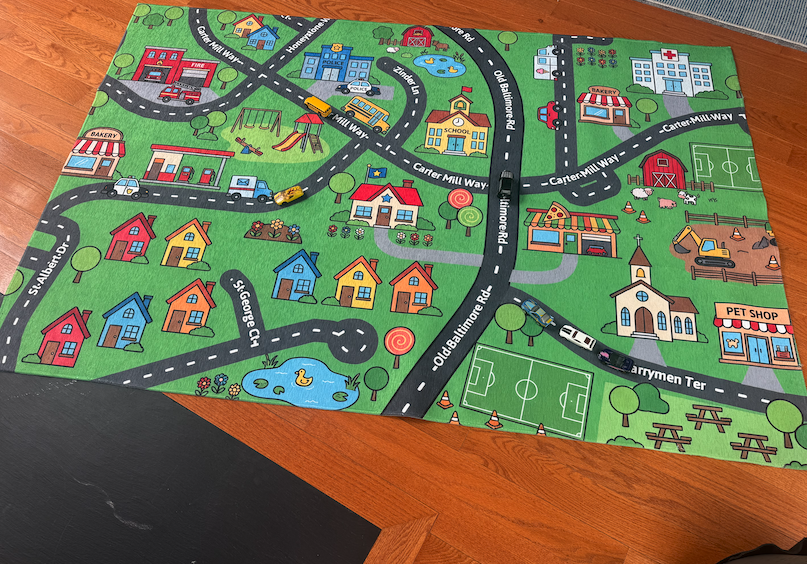
A play mat won't replace a walk around the block. But it gives kids a way to revisit their neighborhood when they can't be outside. To trace the roads with a finger or a toy car, to notice the church steeple and the pond and the funny intersection near school. To build familiarity with a place that is genuinely theirs, at their own pace, from the comfort of the floor.
Their neighborhood. On their floor.
A Little Roads play mat puts your actual streets, landmarks, and home onto a rug made for play. Real geography, kid-friendly illustration, built for the floor.