 LittleRoadsCo.
The toys that do less, do more
Walk into any toy aisle and you'll find hundreds of products competing to grab your kid's attention with lights, sounds, and buttons. The irony is that the toys children actually play with the longest are the ones that don't do anything on their own.
What "open-ended" actually means
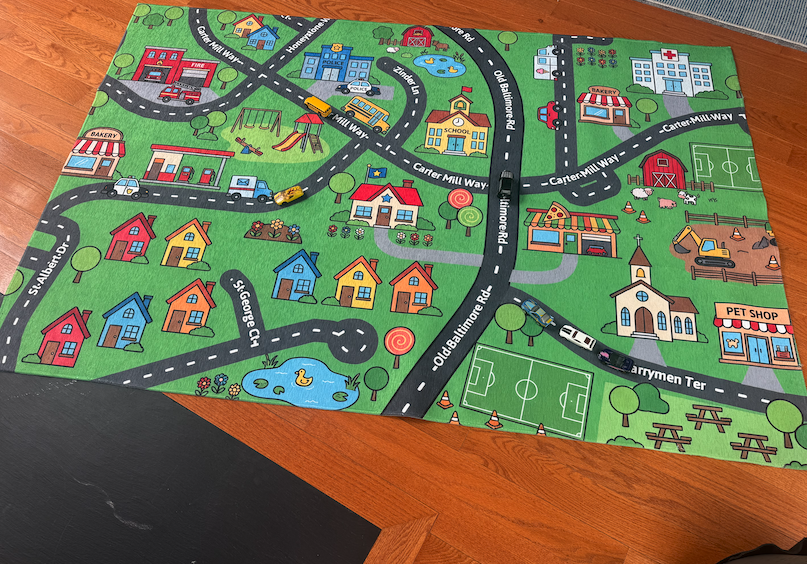
An open-ended toy is one that can be used in more than one way. There's no single correct interaction, no scripted sequence, no "you win" screen. A wooden block is open-ended. So is a doll, a bucket of sand, a cardboard box, or a play mat with roads on it. The child decides what the toy is for, and that decision can change every time they pick it up.
A closed-ended toy, by contrast, has a predetermined use. A puzzle has one solution. A talking robot says the same phrases in the same order. A tablet game funnels the child through a fixed path. These toys aren't bad, but they tend to produce shorter play sessions because the child exhausts the possibilities quickly.
Researchers at Eastern Connecticut State University spent years studying how preschoolers interacted with different toy types. They found that simple, open-ended toys consistently produced the highest quality play across all demographics (Trawick-Smith et al., 2015, Early Childhood Education Journal). The generic wooden figures and plain blocks outperformed the flashy stuff almost every time.
What happens when the toy does the talking
In 2016, Anna Sosa at Northern Arizona University published a study in JAMA Pediatrics that compared how parents and babies interacted during play with three categories of toys: electronic toys, traditional toys, and books. The electronic toys produced fewer words from the parents, fewer back-and-forth conversational turns, and fewer vocalizations from the babies (Sosa, 2016, JAMA Pediatrics).
That finding makes intuitive sense if you think about it. When a toy talks, the parent steps back. Why narrate what's happening when the toy is already doing it? But that parental narration is exactly where a huge amount of early language development comes from. The toy that "teaches" your child the alphabet might actually be displacing the conversation that would teach them more.
None of this means electronic toys are evil. But it does suggest that they work differently than the packaging implies. The toy that seems like it's doing more might actually be creating a situation where everyone else in the room does less.
The case for fewer toys
Parents sometimes assume that more toys means more stimulation, which means better development. The research suggests the opposite. A 2018 study at the University of Toledo gave toddlers either four toys or sixteen toys to play with. The kids with fewer toys played longer with each one and found more creative uses for them (Dauch et al., 2018, Infant Behavior and Development).
Sixteen toys spread across a room creates a kind of decision fatigue for a toddler. They pick something up, put it down, move to the next thing. With four toys, they're more likely to stick with one and figure out what else it can do. The constraint forces creativity. This is something most parents have observed anecdotally on Christmas morning, when the kid ignores the expensive gifts and plays with the box for an hour. The research just confirms what the box already knew.
The theory of loose parts
In 1971, an architect named Simon Nicholson wrote a paper with a great title: "How NOT to Cheat Children." His argument was that the environments we build for kids are too finished. Everything is polished, permanent, and off-limits. A manicured playground with fixed equipment gives children almost nothing to manipulate. But scatter some sticks, shells, fabric scraps, and buckets into that same space and the play explodes (Nicholson, 1971, Landscape Architecture).
Nicholson called this the "theory of loose parts." The idea is simple: the more movable, combinable, rearrangeable elements in an environment, the more creative the play it produces. A fixed plastic slide offers one experience. A pile of planks and crates offers a thousand. The child becomes the designer.
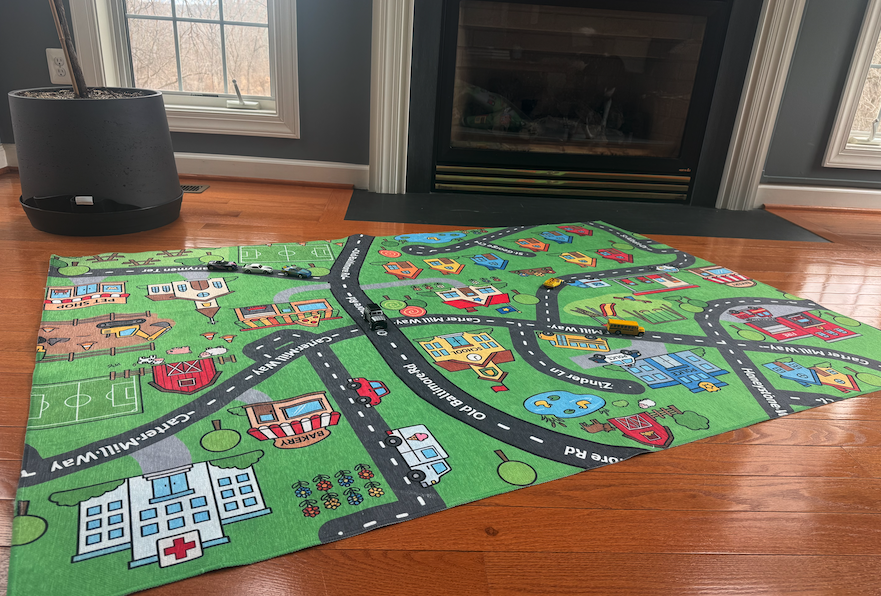
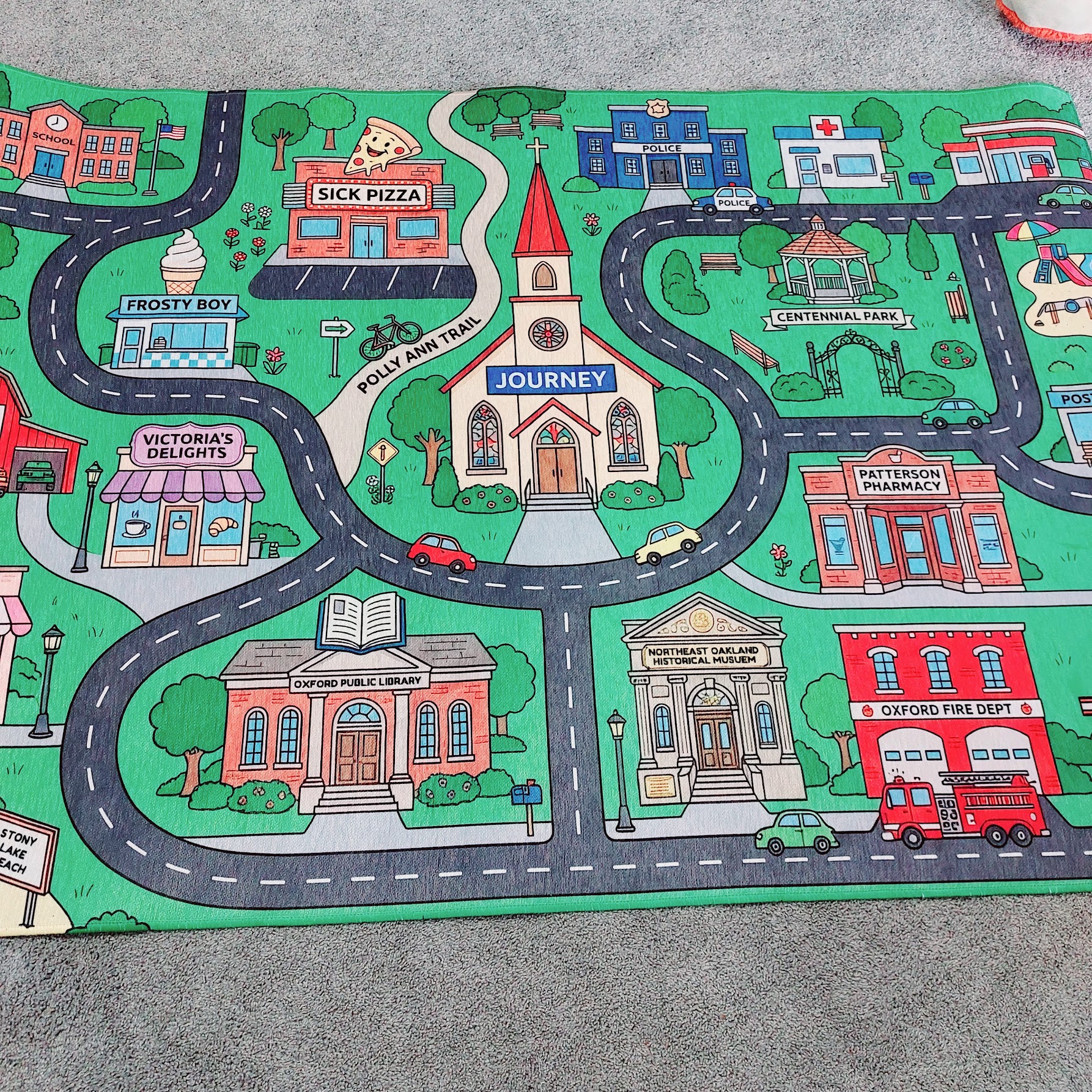
This principle scales down to the living room. A play mat with roads on it is a kind of loose-parts anchor. It provides the geography, and the child supplies everything else. Today the intersections are a traffic jam. Tomorrow they're a race track. Next week they're a neighborhood where all the stuffed animals live. The mat stays the same. The play keeps changing.
Blocks, spatial skills, and why it shows up in math class
Block play is probably the most studied form of open-ended play, and the findings are hard to ignore. A longitudinal study by Wolfgang, Stannard, and Jones tracked children from preschool through high school and found that the complexity of their block play at age four predicted their math achievement years later (Wolfgang et al., 2001, Journal of Research in Childhood Education).
More recent work has confirmed the connection. Verdine and colleagues found that preschoolers' performance on spatial assembly tasks with blocks predicted their early math skills (Verdine et al., 2014, Child Development). The mechanism seems to be spatial reasoning. When a child stacks blocks, they're developing an intuitive understanding of geometry, balance, symmetry, and proportion. Those same mental tools show up again when they encounter fractions and area and angles in school.
Play mats work in a similar register. A child looking down at a top-down map of roads and buildings is practicing spatial relationships constantly. Where is the school relative to the fire station? Which road connects to which? How do you get from here to there? It's geography, topology, and spatial reasoning all at once, and nobody has to tell the child they're learning anything.
Where did all the free time go?
American children have significantly less unstructured play time than they did a generation ago. Time-diary research shows a clear shift: more hours in organized activities, more hours in front of screens, fewer hours in self-directed free play (Hofferth & Sandberg, 2001, Journal of Marriage and Family).
Peter Gray, a research professor at Boston College, has written extensively about this trend and its consequences. He argues that the decline of free play is not just a lifestyle change but a developmental one, with measurable effects on children's sense of autonomy, self-regulation, and mental health (Gray, 2011, American Journal of Play).
The solution isn't to throw out the soccer schedule or cancel piano lessons. Structured activities have their own benefits. But most kids could use more time in their week where nobody is telling them what to do, where the activity has no objective, and where the only measure of success is whether they want to keep doing it. Open-ended toys make that kind of time productive without making it feel like a lesson.
A surface that grows with them
A Little Roads play mat is a real map of a real place, printed on a rug built for the floor. Today it's a racetrack. Tomorrow it's a whole town. The roads stay put. The stories keep changing.