 LittleRoadsCo.
The most productive thing a kid can do is nothing in particular
Somewhere along the way, parents got the message that every hour of a child's day should be accounted for. Soccer practice, tutoring, piano, enrichment camps. The unscheduled afternoon started to feel like a failure of parenting. But the research points in exactly the opposite direction.
What unstructured play actually looks like
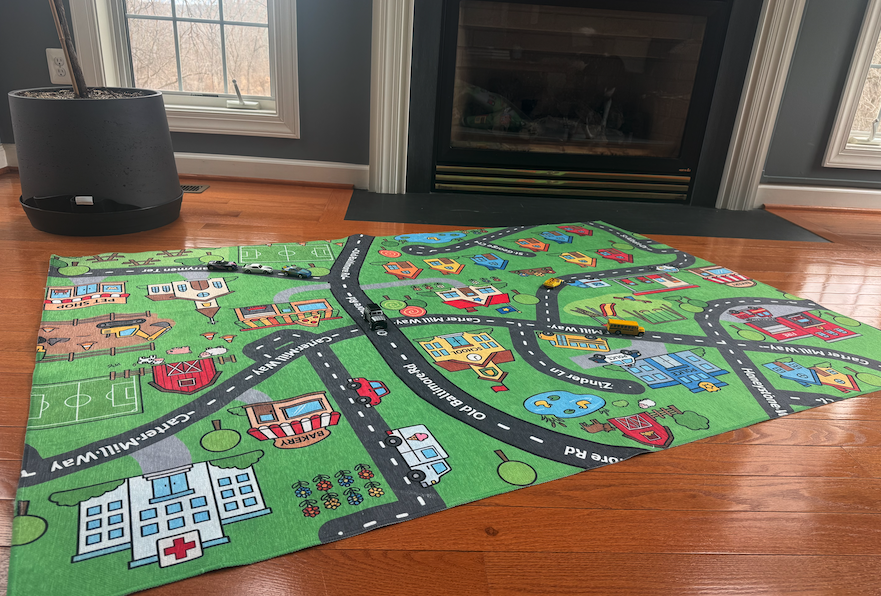
Unstructured play is any play where the child is in charge. There's no coach, no instructor, no set of rules handed down from an adult. The child decides what to do, how to do it, and when to stop. Sometimes it looks like running around in the backyard for no apparent reason. Sometimes it looks like sitting on the floor arranging toy cars into an order that only makes sense to the child doing it.
The defining feature isn't the absence of structure. Kids impose their own structure constantly. They invent rules, assign roles, build sequences. The difference is that the structure comes from them. Nobody is standing on the sideline with a whistle. The child is both the player and the referee, and they can change the rules whenever they want.
This is the kind of play that David Elkind warned was disappearing back in 1981, when he wrote The Hurried Child. It has only become rarer since. The American Academy of Pediatrics felt the situation was serious enough to publish a clinical report specifically about the decline of play and its consequences for child development (Ginsburg, 2007, Pediatrics).
The kids who manage themselves best are the ones who practice it
In 2014, a team at the University of Colorado Boulder published a study that got a lot of attention. They tracked how children spent their time and then measured something called "self-directed executive function." That's the ability to set your own goals, make plans, and carry them out without someone telling you what to do next. The finding was clean: children who spent more time in less-structured activities scored higher on self-directed executive function (Barker et al., 2014, Frontiers in Psychology).
That result makes sense when you think about what unstructured play actually requires of a child. There's no adult telling them what comes next. They have to generate the idea, sustain it, troubleshoot when it falls apart, and decide when to move on. That's a workout for the prefrontal cortex. Structured activities, by contrast, outsource most of those decisions to the instructor. The child follows along, which is a different skill entirely.
Both matter. But if a child's entire week is structured, they're getting very little practice at the kind of self-direction they'll need as teenagers and adults. The unscheduled afternoon isn't wasted time. It's training time.
What happens when adults take over the play
Elizabeth Bonawitz and her colleagues at MIT ran an elegant experiment. They gave preschoolers a toy that could do four different things. With one group, an adult demonstrated one of the functions. With the other group, no instruction was given. The result: the children who received instruction only played with the function they'd been shown. The children left to explore on their own discovered all four (Bonawitz et al., 2011, Cognition).
The researchers called this "the double-edged sword of pedagogy." Teaching is powerful, but it narrows exploration. When an adult says "this is how it works," the child reasonably concludes that the demonstrated use is the interesting one. They stop looking for alternatives. In free play, there's no such signal, so the child keeps experimenting.
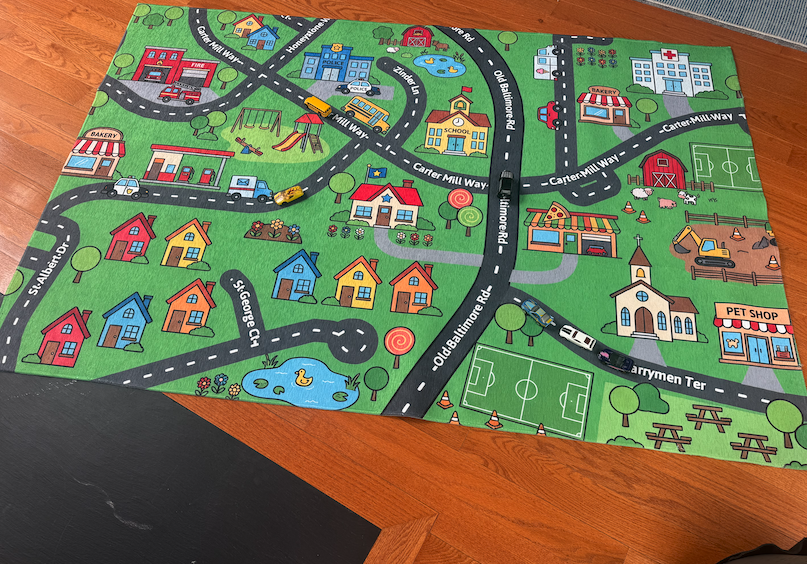
This doesn't mean adults should never play with their kids. It means there's a difference between playing alongside a child and directing the play. Sitting on the floor while your kid drives toy cars around a map is great. Telling them which road to take is less great. The sweet spot is being present without being in charge.
The counterintuitive case for letting them take risks
Free play often involves risk. Climbing something tall. Going fast on a bike. Roughhousing with a sibling. Parents instinctively want to intervene, and sometimes they should. But Ellen Sandseter, a Norwegian researcher who has spent years studying risky play, argues that these experiences serve a specific developmental function.
Sandseter and her colleague Leif Kennair proposed that risky play works as a natural anti-phobia mechanism. Children who are allowed to experience thrilling, slightly scary physical play develop better calibrated risk assessment and less anxiety over time. Children who are consistently prevented from taking physical risks may end up more fearful, not less (Sandseter & Kennair, 2011, Evolutionary Psychology).
The idea is that children need manageable doses of fear in order to learn that they can handle it. A child who climbs a tree and comes back down has learned something about heights, gravity, and their own ability that no adult lecture could convey. Unstructured play is where most of these encounters happen, because structured activities are designed to minimize exactly this kind of uncertainty.
The disappearing recess
The place where most children used to get their daily dose of unstructured play was recess. Twenty minutes, twice a day, outside, no agenda. But schools have been steadily chipping away at that time for decades, particularly after the passage of No Child Left Behind, when test-prep minutes started eating into everything else. A 2010 survey by the Robert Wood Johnson Foundation found that many principals had reduced or eliminated recess to make room for more instructional time.
The irony is that the research consistently shows this is counterproductive. Pellegrini and Davis found that children were more attentive in class after recess, not less (Pellegrini & Davis, 1993, British Journal of Educational Psychology). Ramstetter, Murray, and Garner reviewed the full body of evidence and concluded that recess provides cognitive, social, emotional, and physical benefits that structured physical education cannot replicate (Ramstetter et al., 2010, Journal of School Health).
The mechanism is straightforward. Sustained attention is a limited resource. Children need breaks to replenish it. And the kind of break matters. Sitting quietly at a desk doesn't do the same thing as running around outside with no instructions. The unstructured part is the point.
Boredom is not the enemy
"I'm bored" is one of the most panic-inducing phrases a child can say to a modern parent. The impulse is to fix it immediately. Hand them a screen, suggest an activity, drive somewhere. But there's a growing body of research suggesting that boredom is actually a useful state, not a problem to be solved.
Sandi Mann and Rebekah Cadman at the University of Central Lancashire found that people who had just completed a boring task subsequently performed better on a creative thinking test (Mann & Cadman, 2014, Creativity Research Journal). Their study used adult participants, but the underlying mechanism applies across ages: boredom prompts the mind to wander, and wandering minds generate novel associations.
For children, boredom is often the last stop before invention. The kid who complains there's nothing to do at 2pm is frequently the same kid who has built an elaborate fort by 2:30. The discomfort of having nothing planned pushes them to generate something from scratch, which is a fundamentally creative act. Filling every gap in a child's schedule with stimulation doesn't just prevent boredom. It prevents the thing that comes right after boredom, which is often the most interesting part of the day.
Outside is different
Unstructured play can happen anywhere, but there's something about being outside that amplifies it. Frances Kuo and Andrea Faber Taylor at the University of Illinois studied children with ADHD and found that time spent in green outdoor settings reduced symptoms more effectively than the same amount of time spent indoors or in built outdoor environments (Kuo & Taylor, 2004, American Journal of Public Health).
Ingunn Fjørtoft in Norway compared children who played in natural landscapes with those who used conventional playgrounds. The nature-play group showed improved motor fitness and balance (Fjørtoft, 2001, Early Childhood Education Journal). The natural environment is inherently less predictable than a designed playground, which means the child has to adapt constantly. Uneven ground, sticks, puddles, slopes. Every surface is a new problem to solve with their body.
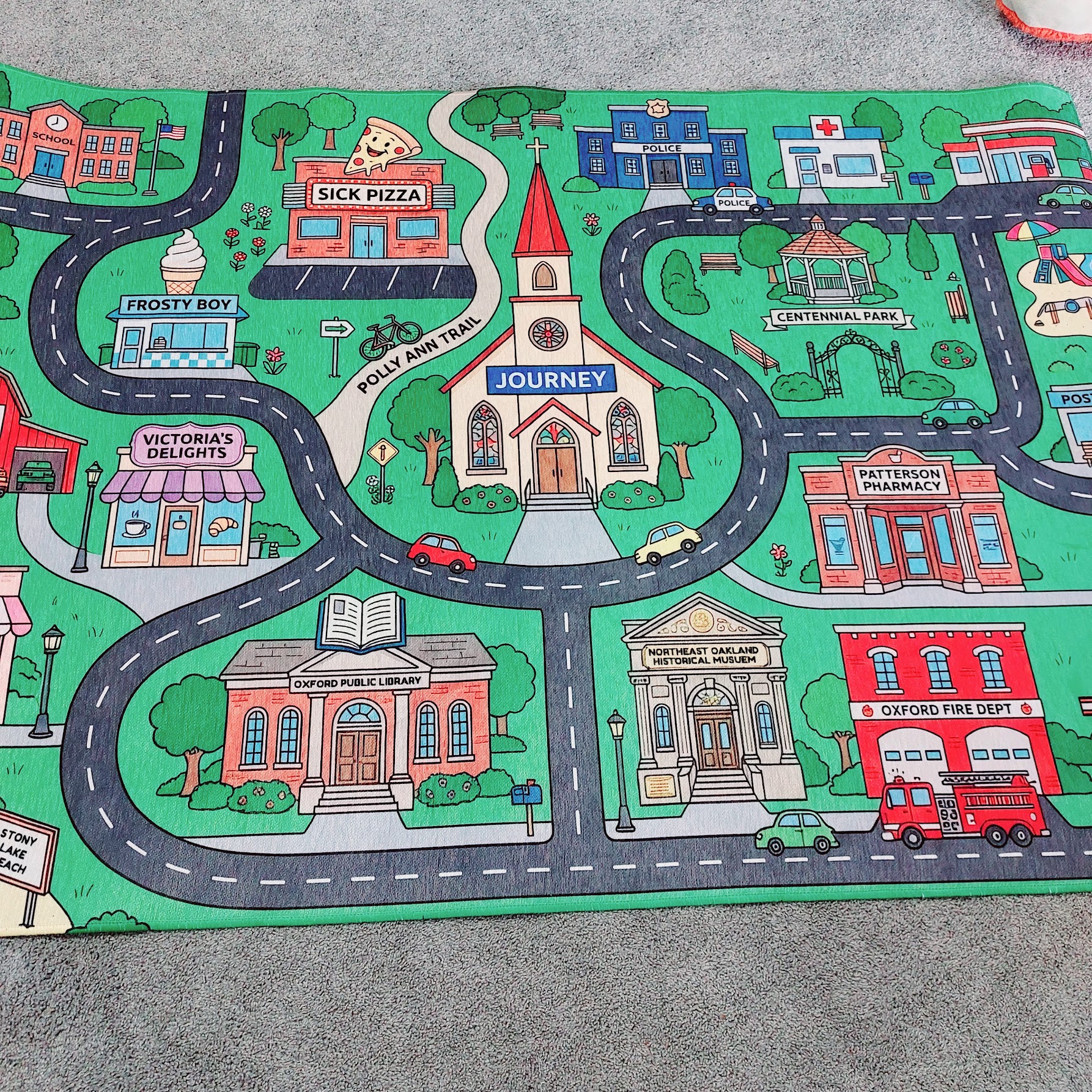
But the reality is that kids can't always be outside. Weather, apartments, safety, schedules. When they're indoors, the question becomes what kind of environment supports the same quality of self-directed play. A clear patch of floor helps. Toys that don't dictate the play help more. And a surface that suggests a world without scripting one helps most of all.
Give them somewhere to go without going anywhere
A Little Roads play mat puts your real neighborhood on the floor. No instructions, no rules, no batteries. Just roads and buildings and a kid who decides what happens next.